


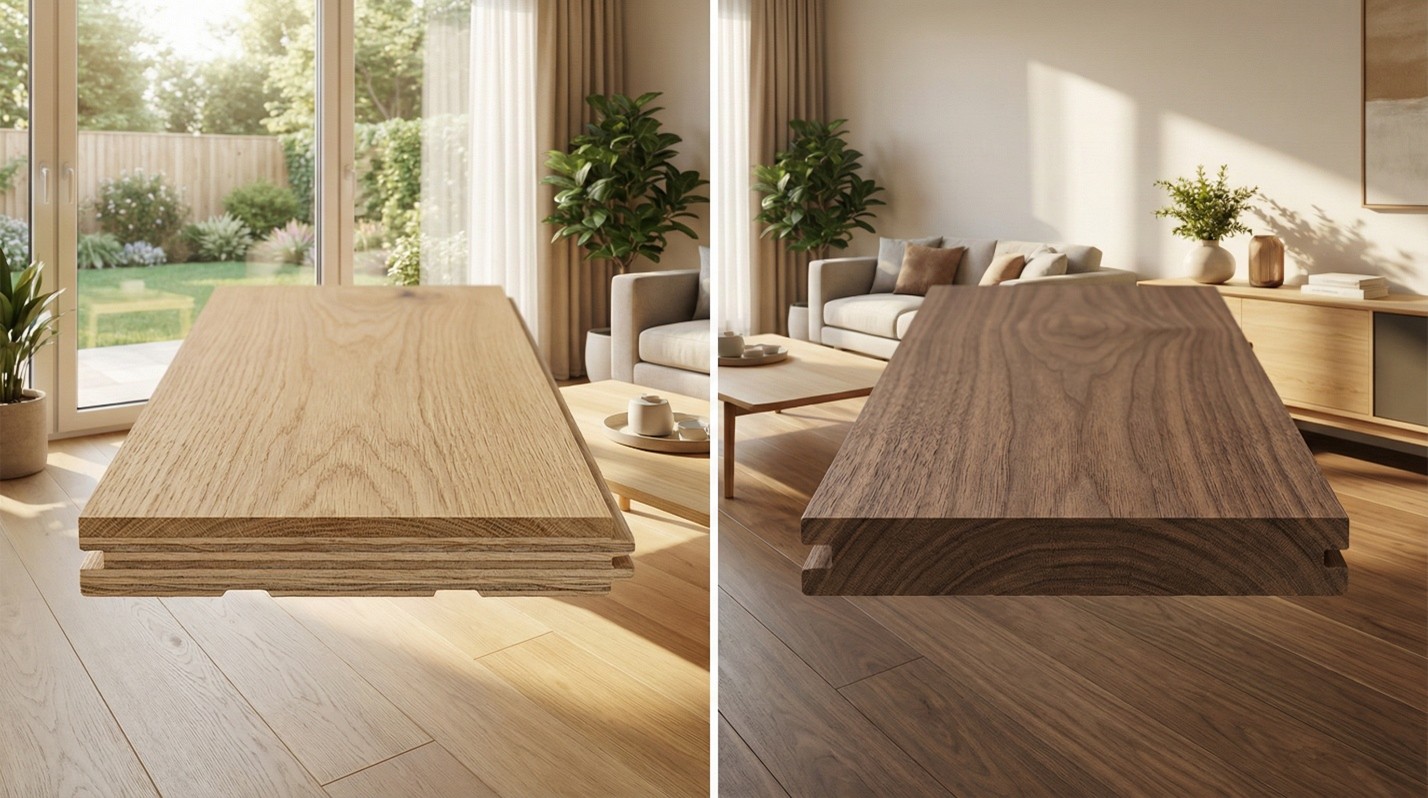
When it comes to enhancing the beauty and value of your home, hardwood flooring often stands out as a top choice. Its timeless appeal and natural elegance can transform any space. However, the world of hardwood isn't as simple as it seems. Homeowners are often faced with a fundamental decision: “engineered hardwood” or “solid hardwood? Some call it the difference between real hardwood and fake hardwood. Both offer the charm of real wood, their construction, performance, and suitability for different environments vary significantly.
This blog post will serve as your ultimate guide, dissecting the key differences between engineered and solid hardwood across three critical aspects: cost, durability, and lifestyle fit. By understanding these distinctions, you'll be equipped to make an informed decision that not only meets your aesthetic preferences but also aligns with your budget, home's specific conditions, and long-term expectations.
You need to understand some basics before diving into comparisons. Let's clarify what each type of hardwood flooring entails.
“Solid” hardwood flooring is the traditional construction, crafted from a single, solid piece of timber, typically ¾ inch thick. Width may vary and how it is cut from the tree may vary giving it a few different looks. Popular North American domestic species include oak, maple, and hickory. Each wood offers unique grain patterns and characteristics. When stained or treated, they will react differently as well. This type of flooring is renowned for its classic appearance and the ability to be sanded and refinished multiple times over its lifespan, potentially lasting up to 100 years with proper care. As an example, old barns and buildings are dismantled every year so that the wood in them can be harvested and used for reclaimed wood flooring.
However, solid wood is hygroscopic, meaning it naturally absorbs and releases moisture based on the surrounding air's humidity. This sensitivity makes it prone to expansion and contraction, which can lead to issues like cupping, crowning, or gapping if not installed in a stable environment. Therefore, solid hardwood is best suited for dry, stable areas of the home, such as the main living area, and generally not recommended for basements, bathrooms, or areas with high moisture fluctuations.
“Engineered” hardwood flooring is also made from 100% real wood, but its construction is fundamentally different. It features a top layer (veneer) of finished hardwood, which is bonded to multiple layers of high-density fiberboard (HDF), SPC, or multi layered plywood beneath. These underlying layers are typically arranged in a criss-cross pattern, providing enhanced dimensional stability. This allows for the planks to be wider and longer than solid wood because of the dimensional stability provided by the layers under it.
This multi-layered construction makes engineered hardwood significantly more resistant to moisture and temperature fluctuations compared to solid hardwood. It can be installed in areas where solid wood struggles, such as basements, kitchens, or over concrete slabs and radiant heating systems. Some advanced engineered products even offer waterproof protection, making them suitable for virtually any room. While engineered hardwood can also be refinished, the number of times depends on the thickness of its top veneer layer, typically ranging from 0 to 3 times. Some engineered products will get the same amount of sanding as solid wood because they make the top veneer the same thickness and the top layer of solid wood before the layer with the nails.
Cost is often a primary consideration for homeowners. When comparing engineered and solid hardwood, it's essential to look beyond the initial purchase price and consider the long-term value.
Solid hardwood generally has a mid-tier to upper cost upfront cost for both materials and installation. The material cost is dependent on a number of things. The wood species, which is what type of wood it is whether Maple, Hickory, or White Oak and so on. The grade of wood is how uniform is appearance and type of cut the wood is. The amount of knots or discoloration in the wood is a factor. Where and who harvest the wood applies to the cost as well. Wood from certain parts of Europe may cost more than red oak from the Appalachian Mountains. Installation can be more labor-intensive because you can also get special sizes to do patterns, mix species or colors, or install over concrete. Solid is often a nail-down process on a wood subfloor but can be installed using adhesive. If you get unfinished solid wood, installation cost can be anywhere because you can treat wood floors like a canvas with mixing colors, cutting out patterns, and using multiple different staining and finishing methods.
Solid hardwood offers excellent long-term value due to its exceptional longevity and the ability to be refinished multiple times. Each refinishing can refresh its appearance, extending its life for decades. If you were to use old world reactive stains and oil finishes, you would never need to sand but clean and apply fresh oil. It is more maintenance, but the beauty of the wood looks amazing.
For a homeowner planning to stay in their home for many years, the higher initial investment in solid hardwood can be offset by its extended lifespan and the ability to renew its look.
Engineered Hardwood Costs
Engineered hardwood is often more widespread in cost, with material costs starting lower than some prefinished hardwood and getting very expensive. Installation is generally faster, as it can be installed using floating, glue-down, or nail-down methods, and can be laid over various subfloors, including concrete. This flexibility in installation methods can significantly reduce labor costs. There is also less pattern installations with engineered hardwood. The sides and surface have set profiles which do not allow for it to be custom cut to make shapes and sizes.
While some engineered hardwood may not have the same multi-generational lifespan as solid hardwood, its lower upfront cost and easier installation make it an attractive option for those on a tighter budget or for projects with specific subfloor requirements. It offers a beautiful real wood aesthetic at a more accessible price point.
The higher end engineered wood products offer finishes and colors that can’t be made with solid hardwood. The veneers can be stained using processes and ways that can only be done in a manufacturing setting. It also gives you a lot of color options, sizes, and thickness to fit different budgets. Many of the higher end products can be sanded 3 times possibly more for some. They also are available in oil finishes that can be re-conditioned over time to keep its beauty. The factory aluminum oxide finishes are harder than home applied finishes, but can also be recoated keeping the floor looking new. Properly maintained, any wood flooring can be kept looking good over time.
Durability is a critical factor, especially in high-traffic areas or homes with pets and children. Both engineered and solid hardwood are durable, but they excel in different aspects. Both do need to be kept clean and the right maintenance done to keep the floors looking new for years.
Most solid hardwood is durable and can withstand significant wear and tear. Some species are softer than others, so look at a Janka score to see the level of durability of the wood flooring is that you are looking at. Its thick construction means that scratches and dents can often be sanded out during refinishing. As mentioned, solid hardwood can be refinished multiple times (typically 4-6 times for a standard ¾ inch plank), allowing it to maintain its appearance for decades. Be aware that sanding a floor isn’t something that can be done to parts of a wood floor. Everything must be removed and the whole floor must be refinished at the same time to keep the same color and look of the floor. This makes it an excellent choice for areas that experience heavy use and where a long-term flooring solution is desired.
However, solid hardwood's primary vulnerability is moisture. Excessive humidity or direct water exposure can cause it to warp, cup, or buckle, leading to irreversible damage. HVAC needs to be kept at a set temperature and maintained year-round. Therefore, its durability is highly dependent on a stable indoor environment with consistent humidity levels.
Engineered hardwood's layered construction provides superior dimensional stability, making it more resistant to moisture and temperature fluctuations than solid hardwood. This enhanced stability means it's less likely to warp or gap in environments with varying humidity, such as basements, kitchens, or coastal regions. Some engineered products are even designed to be waterproof, offering an exceptional level of protection against spills and moisture. It also allows for larger and wider planks because of its stability. Engineered products can also go through different types of staining processes allowing for unique colors that can’t be done with solids.
The durability of engineered hardwood's wear layer (the top veneer) is crucial. Many engineered products feature durable finishes that offer good resistance to scratches, stains, and fading, making them easier to clean and maintain. While the number of refinishes is limited by the veneer thickness, the overall construction often makes it a more practical and durable choice for challenging environments. You may not see the level of wear in an engineered product as you would see in a solid wood floor product.
The best flooring choice ultimately depends on your lifestyle, the specific conditions of your home, and your long-term goals.
Solid Hardwood for Traditionalists and Custom installations
Solid hardwood is ideal for homeowners who appreciate traditional aesthetics and are looking for a flooring solution that can last a lifetime and provide unique and elegant patterns as well.
HVAC systems will need to be maintained and kept at a steady climate control level. Solid wood doesn’t do well with fluctuations in humidity and temperature.
It offers the classic look of regional styles and colors for years of enjoyment. It also allows for custom installations mixing species, colors, and shapes to create totally unique and classic floor patterns and images.
Classic wood flooring installations with solid wood allows for years of enjoyment. It can be sanded and colors changed or finishes to match with what the homeowners want over the years. It does have a limit to the number of refinishing, but it also allows for many years of enjoyment.
Engineered hardwood is a versatile option that caters to a wider range of home conditions and modern lifestyles. It's an excellent choice for both basement and main level installations. It can be installed with adhesives or floating so that it works over any sub floor. It is more resistant to moisture which allows for it to be installed in most of the home. You can also install it over radiant heat so cooler climate areas. The factory finishes also help give it more durability for high traffic and pets.
There are more price levels and qualities with engineered products. For those on a budget, there are options less expensive than solid wood. For those who want beautiful and high quality floors, there are thousands of options of colors, different finishes, and different installation styles to choose from.
The debate between engineered hardwood and solid hardwood isn't about one being inherently superior to the other; rather, it's about choosing the right flooring for your specific needs, budget, and lifestyle. Both offer the undeniable beauty and warmth of real wood, but their distinct characteristics make them suitable for different applications.
Solid hardwood remains the classic choice for those seeking timeless elegance, multi-generational longevity, and the ability to refinish their floors numerous times. It thrives in stable environments and offers a higher resale value, making it a sound long-term investment for traditional homes. Also great for patterns and design installations.
Engineered hardwood, with its innovative construction, provides unparalleled versatility and moisture resistance. It's the ideal solution for challenging environments like basements and kitchens, homes in humid climates, or installations over concrete and radiant heat. Its often lower cost and easier installation also make it a practical choice for modern living and budget-conscious renovations. With newer waterproof and pet friendly finishes it is a great choice for families.
Ultimately, the best way to decide is to carefully assess your home's conditions, your family's lifestyle, and your long-term goals. Consider consulting with a flooring professional who can provide personalized advice based on your unique circumstances. By weighing the cost, durability, and lifestyle fit of each option, you can confidently select the hardwood flooring that will bring beauty and value to your home for years to come.


